
Taxonomy First
The invisible work that elevates everything you build


I’ve been focused for a couple of weeks on designing the structure of my underlying knowledge base.
Fun stuff. The number of things I’ve had to think through is mind-numbing. (Literally, my mind feels a little numb.) And it’s all been for this—the PDF report you see below—which looks pretty good at first glance, but when you read the columns, you see the kinks.
Since this is building in public, you can create your own report, kinks and all!
Just go here, select any filters you want, and click “Create report”.
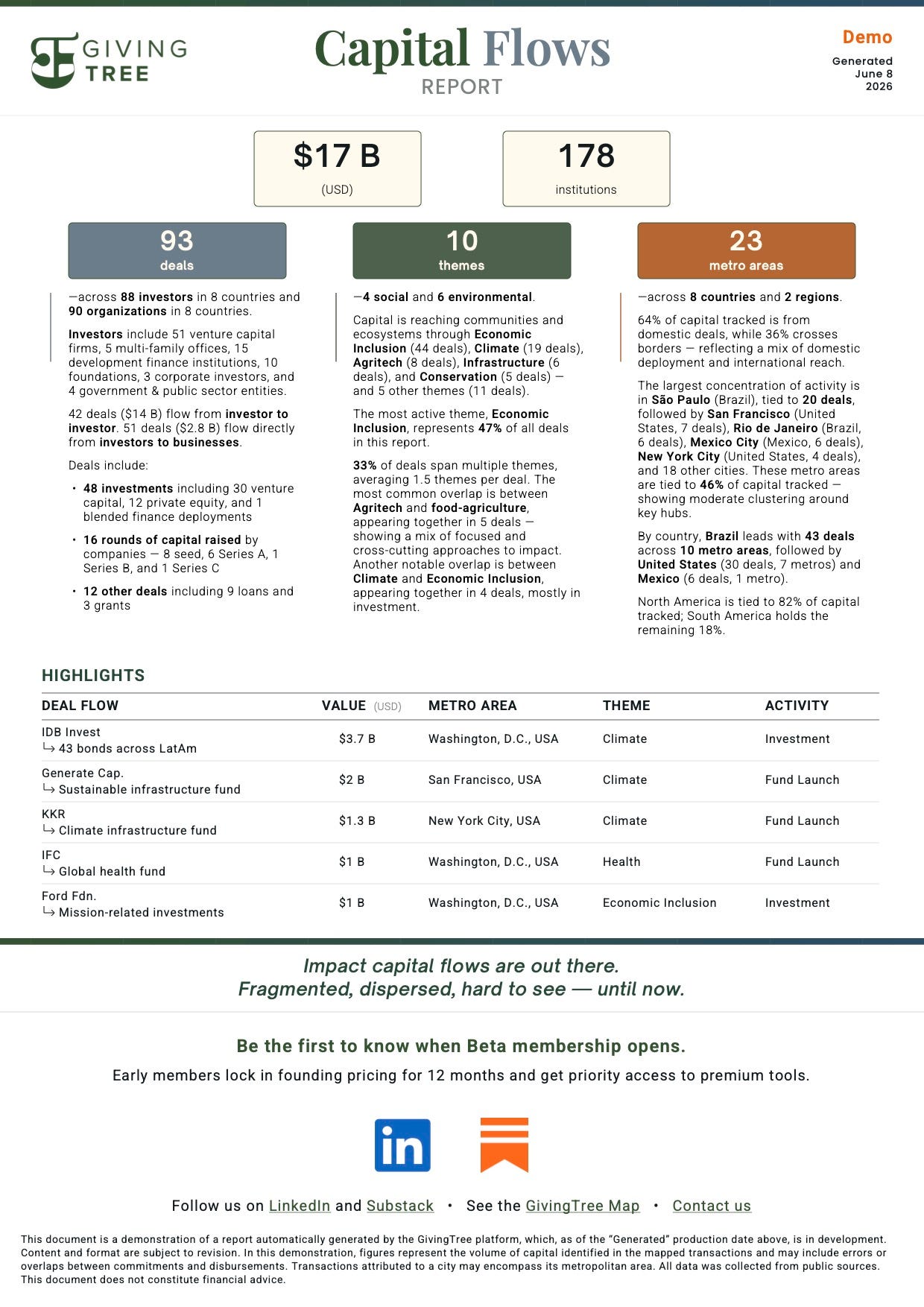
I spent hours and hours and hours and hours and days (and hours) on this PDF — especially the columns. And it's still far from perfect.
Honestly, if I didn't have an endless supply of motivation for what I'm doing, this might have knocked me down. (But it didn't and won't.)
This PDF report is the tip of the taxonomic iceberg.
Underneath it, in the way ice crystals form in an actual iceberg, a knowledge system is forming. I'm mapping out rules for how my system identifies data, connects dots, and presents them. And the lessons from that work apply to anyone who deals with information for a living.
For example:
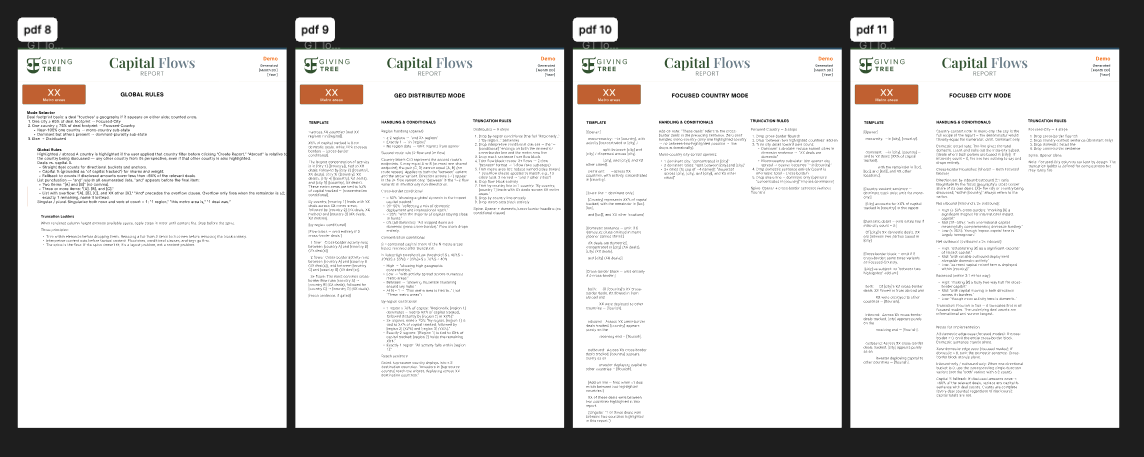
This is my homework in designing column 3 of the PDF, which gives the geographic information.
Column 3 is titled “metro areas” after the highlighted stat. The system can write it in three “modes” (distributed, focus-country, and focus-city), depending on what geographies you select on the map filters.
Beyond that, both “focus” modes have two “tracks” — one for a country or city as the sole geography selected, and one for when it’s the dominant (but not sole) location, representing 70 to 99% of the deals identified in the report.
I know! It’s fun stuff!
But getting this right is critical. Designing it correctly up front will have positive ramifications that branch out across everything else I build.
So there’s no choice. It’s gotta be done right.
What the fight looks like
When you build systems like these, you see everything that goes into them. Every word. Every rule. Every ripple effect. Every edge case that breaks the moment the data does something you didn’t expect.
I have fought a few taxonomic skirmishes over the past two weeks. Here’s one.
The battle between “investors” and “recipients”
The first one shows up at the top of column 1, and it’s a battle I’m still fighting.
It sounds simple — money moves from an investor to a recipient.
What I really want to distinguish is (1) investors and (2) “recipient non-financial organizations” — companies and nonprofits that receive investments but aren’t registered financial institutions. You know, regular companies and nonprofits.
But investors can also technically be “recipients” when they manage funds downstream from another investor. Investment companies are also “companies” but nonprofits technically are not. Any incorporated group of people is an “organization”. Financial institutions can be nonprofits or government entities.
So the accurate term is “non-financial organization.”
But that’s imprecise and unclear in context. So it’s out.
I’ll probably end up writing “companies*” or “organizations*,” with an asterisked footnote at the bottom of the column or page. It’s not what I’d want. But clarity is so important here that I’m willing to make an exception. TBD if I find a better solution.
That’s the whole game, right there: a word that’s accurate but confusing against a word that’s clear but slightly imprecise, and you have to choose — knowing the choice ripples through every report the system will ever generate.
I’ve been through a hundred such battles of logic and language.
The deeper win, and the harder truth
Beneath the columns, the knowledge architecture was built.
I’m moving my underlying knowledge base from Airtable to Supabase — a platform that’s more technical but that can handle larger, more complex systems of information.
In doing so, I demolished some structures and built some better ones. Two tables called “investors” and “recipients” become one — Entities — which tags each organization with identifiers for the roles it plays.
The “Deals” table became “Activities” because that title gives the table the flexibility to map not only financial transactions but also partnerships, events, and program launches.
The new model is more honest and more precise.
Taxonomy itself is only half the battle.
Next comes triage, verification, and the coordination of information into real knowledge.
It’s the next layer, and it could end up being far more complex than the taxonomy part. How do I train the system to reliably — or 99.999% of the time — deliver verifiable, cited information?
With a system this large, cracks can show up. I need to keep this knowledge that goes through my system sealed tight through an intelligent system of prompts. I need to study how Perplexity does it. I need to look into a concept called “formal verification” that I heard about on a podcast.
And then I need to triage information to exactly the points where it needs to show up, so it reliably feeds you top-quality information in a top-quality experience.
All of that is still ahead.
The move that changes the math
Toward the end of all this, I decided I need a better way to fight these battles of logic and information.
So I asked Claude to build a “critical thinking” skill that runs an eight-pass audit on any system before the work comes back to me — unit and cardinality, edge cases, redundancy, word-to-reality precision, and so on down the list.
So now I have AI go fight these battles for me, or at least clear the way to make my job much easier.
Why there’s no choice
Here’s what makes the mind-numbing work worth it.
Right now, all I’ve mapped is the architecture of the movement of finances in the do-gooder economy. But that’s the seed, not the tree. Once we start building in other types of information — historical, legislative, scientific, cultural — all the things we need to tell the complete story of the movement to make the world a better place, it’s going to get far more complex.
Bring it on. I can take complex and turn it into gold. Everything built on top will be better than anything else out there, precisely because of the time and energy I’ve put into the taxonomy. This is the foundation of the building. The groundwork everything else stands on. The germination the seed needs to pop and sprout in a healthy way.
And honestly? I feel like I just did the mental equivalent of a week of intensive physical training. Now I need a sabbath. When I come back from that rest — doing less mentally taxing things for a stretch — I’ll be even stronger. The brain is a muscle. If you’re heading into ordeals like this, you have to train it, the same as an athlete trains to win.
That’s the part I’d hand to you, if you’re a knowledge worker, or anyone who builds and works inside systems: the unglamorous, mind-numbing fight to get the structure right is not a detour from the work. It is the work. Understand that, and it elevates everything else you do.
It’s the mental energy that turns the seed into a sprout into a tall, mighty tree. 🌱
The GivingTree Map is an interactive visualization of global impact capital flows, live at givingtree.com.br/map. This post is part of an ongoing build-in-public series.